
Monetizing a new website or a niche blog with modest traffic numbers is one of the most frustrating hurdles digital publishers encounter. Premium managed ad management platforms like Raptive and Mediavine demand 50,000 to 100,000 monthly sessions before even reviewing an application. Consequently, emerging webmasters often assume they must wait years before generating real display advertising income. Fortunately, identifying the most lucrative ad networks for low traffic sites enables webmasters to unlock competitive impression yields from day one.
In 2027, the ad technology ecosystem has evolved dramatically. Modern programmatic exchanges, algorithmic multi-format units, and automated yield optimizers now allow publishers with fewer than 10,000 monthly pageviews to capture competitive CPMs. In this guide, we break down the leading ad networks catering to low-traffic websites, comparing approval hurdles, average CPM benchmarks, payment thresholds, and optimal ad formats to maximize your early monetization velocity.
Key Criteria for Evaluating Small Publisher Ad Networks

When your site generates limited traffic volume, your monetization calculus differs fundamentally from enterprise media companies. Small publishers cannot afford networks that enforce aggressive minimum payment thresholds or penalize low impression volume with artificially depressed bids. When evaluating monetization partners, keep four operational criteria top of mind:
- Traffic and Entry Thresholds: Does the ad platform enforce a rigid monthly session minimum, or does it evaluate applications purely based on content quality, originality, and domain hygiene?
- Minimum Payout Thresholds: A network requiring a $500 minimum payout can lock up your cash flow for months. Platforms offering $5 to $50 payment floors ensure agile liquidity for reinvesting in content and hosting.
- Auction Depth and Fill Rates: Low traffic volumes require a network capable of delivering 95% to 100% global fill rates across both Tier 1 and emerging geographic markets.
- Ad Quality and Core Web Vitals Impact: Intrusive scripts that trigger browser warnings or drag down Interaction to Next Paint (INP) and Largest Contentful Paint (LCP) can permanently damage organic search visibility.
Top Ad Networks for Low Traffic Sites: 2027 Benchmark Comparison
The following comparison table highlights key operational metrics, approval rules, and earnings benchmarks across the top advertising networks tailored for early-stage and growing websites:
| Ad Network | Minimum Traffic | Primary Ad Formats | Minimum Payout | Average CPM Benchmark | Payment Terms |
|---|---|---|---|---|---|
| Google AdSense | Zero requirements | Display, In-feed, Vignettes, Anchor | $100 | $1.20 - $4.50 | Net-21 |
| Monetag | Zero requirements | MultiTag, Popunder, In-Page Push, Interstitials | $5 | $1.50 - $6.80 | Weekly / Net-30 |
| Adsterra | Zero requirements | Social Bar, Popunders, Banners, Direct Link | $5 ($100 Wire) | $1.80 - $7.20 | Net-15 (Bi-monthly) |
| Media.net | No set minimum (Quality English content) | Contextual Display, Search Highlights | $100 | $2.50 - $8.00 | Net-30 |
| Infolinks | Zero requirements | In-Text, In-Fold, In-Tag, In-Screen | $50 | $0.80 - $3.20 | Net-45 |
In-Depth Review of the Leading Small Publisher Ad Networks
1. Monetag: AI-Driven Multi-Format Yield Optimization
Monetag (formerly PropellerAds) has established itself as one of the most flexible ad platforms for small webmasters, hobbyist blogs, and international niche projects. Monetag has completely eliminated minimum traffic restrictions, meaning a blog created yesterday with 10 visitors can obtain an approved account within minutes.
The core advantage of Monetag is its proprietary MultiTag implementation. Rather than forcing webmasters to manually test and configure individual display slots, MultiTag utilizes machine learning algorithms to detect user device types, network latency, and session depth to deploy the highest-yielding ad format dynamically. High-performing options include In-Page Push (which avoids browser permission dialogs), Interstitials, and Smartlinks.
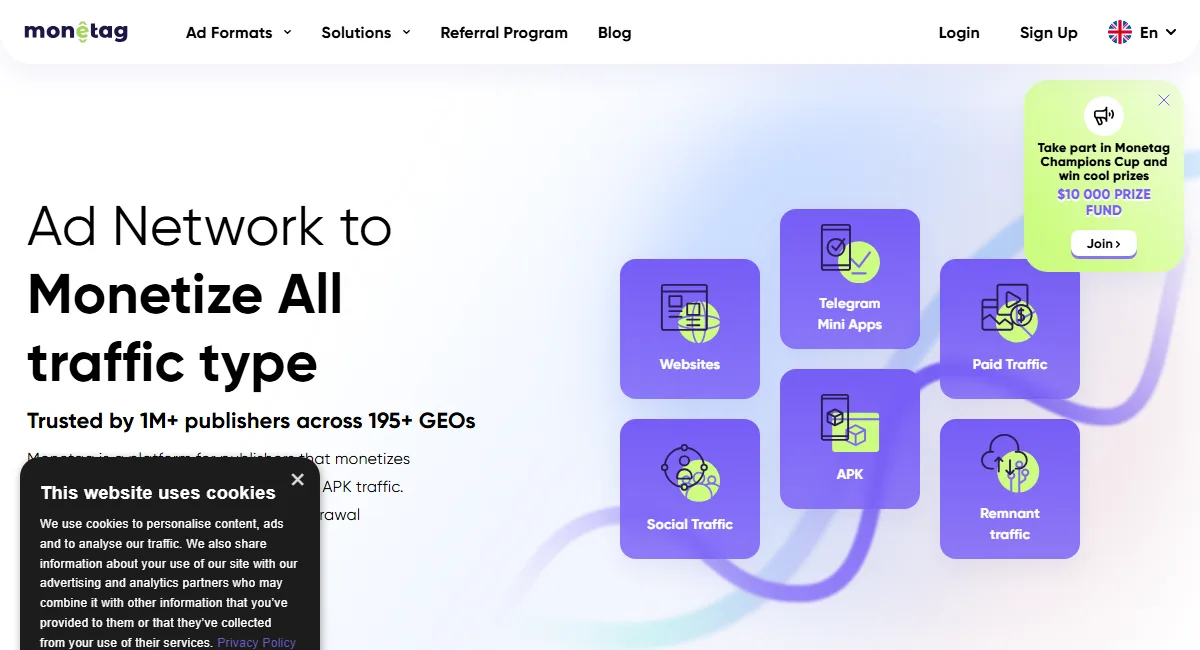
Furthermore, Monetag boasts an accessible $5 minimum payout threshold via payment methods like PayPal, WebMoney, and Skrill. Weekly payouts become available once your domain establishes steady traffic patterns, allowing small publishers to reinvest revenue without bureaucratic delays.
2. Adsterra: High Fill Rates and Innovative Social Bar Formats
Adsterra stands out as another top contender among ad networks for low traffic sites, processing over 30 billion ad impressions monthly. Adsterra approves new domains within 10 to 15 minutes without scrutinizing traffic stats, making it an excellent fallback or primary engine for young blogs.
Adsterra's signature ad format is the Social Bar. Operating as an interactive, customizable floating widget, Social Bar units resemble push notifications, chat bubbles, or mini-banners without triggering intrusive browser ad-blocker protocols. Because Social Bar units feature click-through rates (CTR) up to 20 to 30 times higher than classic rectangular display banners, publishers generate substantial CPM yields even on modest pageview volumes.
Adsterra offers automated bi-monthly payments with a $5 minimum threshold on Paxum and WebMoney, alongside $100 limits for PayPal and wire transfers. Their multi-layered fraud detection ensures ad creatives remain clean and malware-free, protecting your brand reputation.
3. Google AdSense: The Global Baseline for Clean Monetization
Despite increased competition, Google AdSense remains the most universally recognized starting point for small publishers. AdSense enforces no explicit monthly visitor minimum, evaluating websites entirely on compliance with Google Publisher Policies, original value-add content, and site layout usability.
AdSense operates on a pure cost-per-impression (CPM) revenue model, sharing 68% of programmatic auction clearing revenues directly with webmasters. While AdSense's $100 payout threshold requires patience for microscopic sites, its ad inventory quality, unobtrusive Auto Ads machine learning placements, and seamless integration make it an essential foundational network. Combining AdSense standard banners with specialized formats from non-competing networks often delivers peak revenue efficiency.
4. Media.net: Premium Search Intent Contextual Ads
Publishers producing in-depth, high-intent editorial content in English should strongly consider Media.net. As the official operator of the Yahoo! Bing Contextual Ad Network, Media.net matches keyword-driven search ads directly to the thematic substance of your articles.
While Media.net does not advertise a strict traffic minimum, they enforce rigorous quality guidelines: your blog must feature original English text, clean navigational structure, and substantial traffic originating from Tier 1 territories like the United States, United Kingdom, and Canada. In commercial niches such as personal finance, B2B software, and healthcare, Media.net CPM rates regularly match or outperform standard AdSense units.
5. Infolinks: Non-Intrusive Complementary In-Text Monetization
Infolinks specializes in contextual, in-text, and native advertising units that integrate seamlessly into existing article copy. Because Infolinks ad formats (such as In-Fold, In-Text hyperlinked phrases, and In-Tag keyword bars) do not occupy standard banner display slots, you can run Infolinks alongside Google AdSense or Monetag without crowding your layout or triggering policy violations.
Infolinks requires zero minimum visitors to apply, maintains a reasonable $50 payout threshold via PayPal, and delivers consistent incremental income for content-rich information blogs.
Best Practices to Boost Ad Earnings on Small Websites
Publishers managing low-traffic websites frequently make the error of plastering dozens of ad units across their pages in a desperate attempt to boost earnings. This strategy inevitably backfires: it destroys page loading speed, increases user bounce rates, and lowers the Active View Viewability metrics that advertisers demand. Instead, execute these proven revenue optimization tactics:
- Prioritize 70%+ Ad Viewability: Programmatic advertisers pay dramatic premiums for ad impressions that remain visible on screen for at least 1 to 2 seconds. Place sticky bottom anchors and in-content units directly adjacent to high-engagement paragraphs.
- Deploy Responsive Sticky Anchors: Sticky footer anchor banners consistently achieve 85% to 92% viewability rates on mobile smartphones, delivering the highest baseline CPMs across small traffic samples.
- Pair Display with Complementary Units: Run clean AdSense or Media.net contextual units in the primary content stream, while deploying Monetag In-Page Push or Infolinks in-text units to monetize secondary interaction points.
- Target Search Queries with Commercial Intent: Rather than chasing broad informational queries with low advertising bid depth, craft content around buyer comparisons, software reviews, and transactional product roundups where advertisers bid top dollar.
Strategic Action Plan for Small Site Monetization
Monetizing a low-traffic website successfully is entirely about strategic alignment rather than sheer visitor volume. Start by securing baseline approval on Google AdSense to establish a clean contextual banner foundation. Concurrently, integrate Monetag MultiTag or Adsterra Social Bar units on high-traffic landing pages to capture aggressive non-display yields with low $5 payout agility.
As your search engine authority builds and monthly session metrics climb toward the 25,000 to 50,000 milestone, reinvest early ad profits into targeted keyword research and premium hosting infrastructure. By optimizing ad viewability, maintaining strict user experience standards, and diversifying ad partners early, small publishers position themselves for explosive revenue growth when traffic scales.