When publishers configure Google AdSense Auto Ads to scale website revenue, two specialized formats consistently deliver the bulk of incremental earnings: Anchor ads and Vignette ads. While traditional in-page display banners often suffer from banner blindness and variable viewability, both Anchor and Vignette units command elevated advertiser demand. However, in the debate over Anchor Ads vs Vignette Ads, webmasters frequently ask: which ad format actually pays more, and which is better for long-term website growth?
The short answer is nuanced: Vignette ads deliver significantly higher cost-per-thousand (CPM) rates on an individual impression basis, but Anchor ads generate far higher total impression volume across a user's browsing journey. Understanding how these formats perform, how advertisers value them, and how to implement them without frustrating visitors is the key to unlocking peak revenue per thousand sessions (Session RPM) in 2027.
Understanding the Contenders: How Each Format Operates

Before analyzing revenue yields, publishers must recognize how each format interacts with website visitors and browser viewports:
- AdSense Anchor Ads: Anchor units are sticky banner advertisements that remain fixed to the edge of the screen (typically the bottom on mobile devices or the top/bottom on widescreen desktop displays) as the user scrolls. Users can dismiss the unit using a small collapsible arrow tab, but while visible, the ad guarantees uninterrupted viewability without blocking the core editorial content.
- AdSense Vignette Ads: Vignettes are high-impact, full-screen interstitial advertisements that appear between page loads when a visitor clicks an internal hyperlink to navigate from one page on your domain to another. Users can easily close the ad via a prominent exit button to continue reading the destination page.
Anchor Ads vs Vignette Ads: Comprehensive Performance Comparison
The table below provides a detailed side-by-side evaluation of commercial performance metrics, operational mechanics, and reader experience factors:
| Metric / Attribute | AdSense Anchor Ads | AdSense Vignette Ads |
|---|---|---|
| Ad Delivery Mechanics | Persistent sticky edge banner | Fullscreen interstitial overlay |
| Trigger Event | Immediate page load and scroll | Internal link navigation click |
| Average Active View Viewability | 82% - 94% | 98% - 100% |
| Average CPM Benchmark (Tier 1) | $2.50 - $6.50 | $9.00 - $28.00 |
| Average Click-Through Rate (CTR) | 0.60% - 1.40% | 2.20% - 5.50% |
| Impression Frequency per User | Every pageview (100% coverage) | Capped by Google (e.g. 1 per 10 mins) |
| User Intrusiveness Level | Minimal to Moderate | Moderate to High |
| Device Compatibility | Mobile and Desktop screens | Mobile and Desktop screens |
Which Pays More: Analyzing CPM vs Total Session Revenue
When assessing whether Anchor ads or Vignette ads pay more, publishers must distinguish between raw impression CPM and aggregate Page RPM:
Why Vignette Ads Win on Unit CPM Rates
From a pure cost-per-impression standpoint, Vignette ads win decisively. In Tier 1 regions such as the United States, United Kingdom, and Canada, Vignette CPM rates routinely range between $10 and $30, with competitive finance, legal, or SaaS niches occasionally exceeding $45 CPM. Advertisers pay an enormous premium for Vignettes for three reasons:
- Zero Content Distraction: The ad unit captures 100% of the reader's visual attention on both mobile and desktop screens.
- Guaranteed Viewability: Because the creative renders in full view before the destination page appears, viewability scores consistently register near 100%.
- Exceptional Engagement: Vignettes achieve CTRs that are 3 to 6 times higher than standard in-content or sidebar banners.
Why Anchor Ads Provide Greater Revenue Stability
While Vignette CPMs are significantly higher, their impression volume is naturally constrained. A visitor browsing four articles on your site might encounter a Vignette only once or twice due to Google's built-in frequency capping algorithms. In contrast, an Anchor ad serves on every single pageview. Over a multi-page session, three or four Anchor impressions earning $4.00 CPM often generate comparable or superior total revenue compared to a single $12.00 Vignette impression.
User Experience, SEO, and Google Search Compliance
Publishers often worry whether full-screen Vignette interstitials violate Google Search's strict "Intrusive Interstitials" policy. The answer lies in how Google engineered the format:
Google's search ranking penalty penalizes intrusive interstitials that pop up immediately when a user lands on a webpage directly from Google Search results. Because Google AdSense Vignette Ad Guidelines strictly forbid ads on entry page loads, Vignettes fire only during internal user transitions. This design ensures 100% compliance with Google Search SEO guidelines and Better Ads Standards.
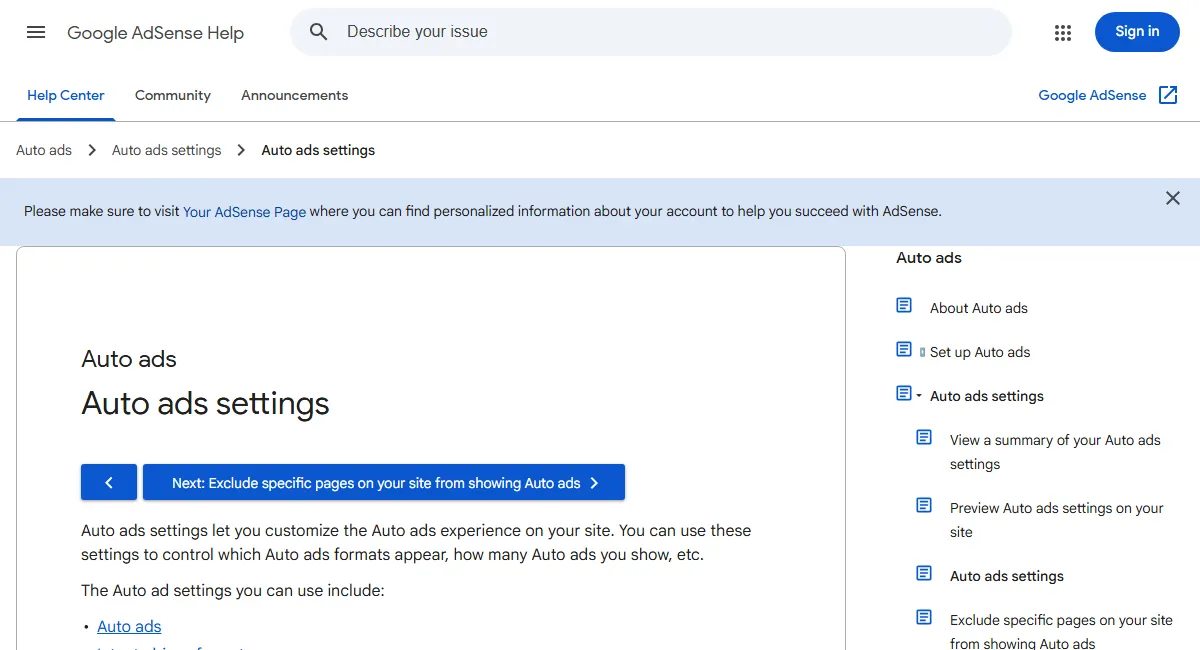
Furthermore, under Google AdSense Auto Ads settings, webmasters can control the minimum delay between Vignette impressions, ranging from 1 minute up to 1 hour, allowing you to strike the perfect balance between revenue monetization and user retention.
Revenue Optimization Blueprint: Deploying the Ideal Hybrid Stack
The optimal monetization strategy is not to pick one over the other: it is to deploy both formats harmoniously as a unified overlay layer. Follow these actionable configuration best practices:
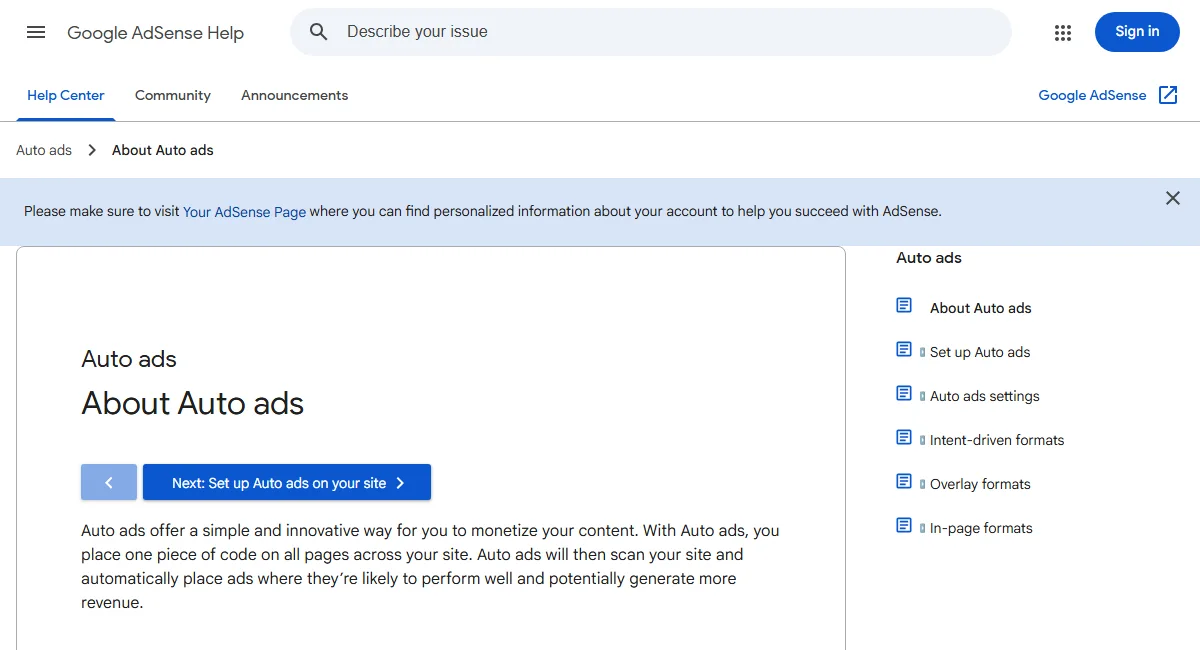
- Activate Both Formats in Auto Ads: Navigate to your AdSense dashboard under Ads > By site > Auto ads settings. Under the Overlay formats menu, toggle on both Anchor ads and Vignette ads. Enable Widescreen support so both formats monetize desktop visitors as well as mobile traffic.
- Calibrate Vignette Frequency Timing: Navigate to the Vignette frequency slider in your Auto ads controls. For editorial blogs and content sites, set the frequency interval between 5 and 10 minutes. This prevents repetitive popups for power readers while capturing high-value transitions.
- Exclude Transactional and Privacy Pages: Use the Page exclusions feature in AdSense to disable Vignettes and Anchors on checkout pages, contact forms, login portals, and privacy policy pages where distractions harm user trust.
- Keep Anchor Collapsible Controls Intact: Never use custom CSS or JavaScript to hide the Anchor dismiss arrow or force unclosable viewports. Keeping user controls intuitive ensures zero policy friction with Google ad enforcement teams.
By pairing the consistent, high-viewability baseline of Anchor ads with the premium CPM bursts of Vignette interstitials, publishers typically observe a 30% to 55% jump in overall AdSense Page RPM without compromising user retention or organic search rankings.